
Views: 0 Author: Site Editor Publish Time: 2025-12-04 Origin: Site


Switching to a solar-powered water system is a smart move for efficiency and sustainability. A key component of this system is the submersible pump, which works wonders for wells, irrigation, and other water transfer needs. But a common question arises when planning the switch: how many solar panels are actually needed to run a submersible pump effectively?
Determining the right number of solar panels isn't a simple one-size-fits-all answer. It involves understanding your pump's power requirements, the amount of sunlight your location receives, and the specifications of the solar panels themselves. Getting this calculation right is crucial for ensuring your pump operates reliably and meets your water demands throughout the day.
This guide will walk you through the essential factors to consider when sizing your solar array for a submersible pump. We’ll cover everything from calculating your pump's energy consumption to understanding solar panel ratings, helping you design an efficient and effective submersible solar pump system.
Before you can determine the number of solar panels, you first need to understand the energy requirements of your submersible pump. This information is the foundation of your entire solar power calculation.
The most important details are usually found on the pump's label or in its user manual. Look for the following key metrics:
Horsepower (HP): This measures the pump's motor power. A higher horsepower means the pump can move more water or push it over a greater distance, but it also requires more energy.
Voltage (V): This indicates the electrical potential the pump is designed to operate on. Submersible pumps can be DC (Direct Current) or AC (Alternating Current) and come in various voltage ratings (e.g., 12V, 24V, 48V for DC; 115V, 230V for AC). Your solar panel system must match this voltage.
Amperage (Amps): This is the measure of electrical current the pump draws while operating.
Wattage (W): This is the total power consumption of the pump and is the most direct measure of its energy needs. If the wattage isn't listed, you can calculate it by multiplying the voltage by the amperage (Watts = Volts × Amps).
For example, a 1 HP pump typically consumes about 746 watts. However, it's always best to check the manufacturer's specific rating, as efficiency can vary between models.
Next, you need to estimate how many hours per day your pump will run. This depends entirely on your water needs. Are you using it for continuous irrigation, or just to fill a water tank for a few hours each day?
Once you have an estimate for the daily run time, you can calculate the total daily energy consumption in watt-hours (Wh).
Daily Energy Consumption (Wh) = Pump Wattage (W) × Daily Run Time (Hours)
Let's say you have a 500-watt pump that you need to run for 4 hours a day.
500 W × 4 hours = 2,000 Wh (or 2 kWh) per day
This 2,000 Wh figure is the target amount of energy your solar panels need to generate each day to power your pump.
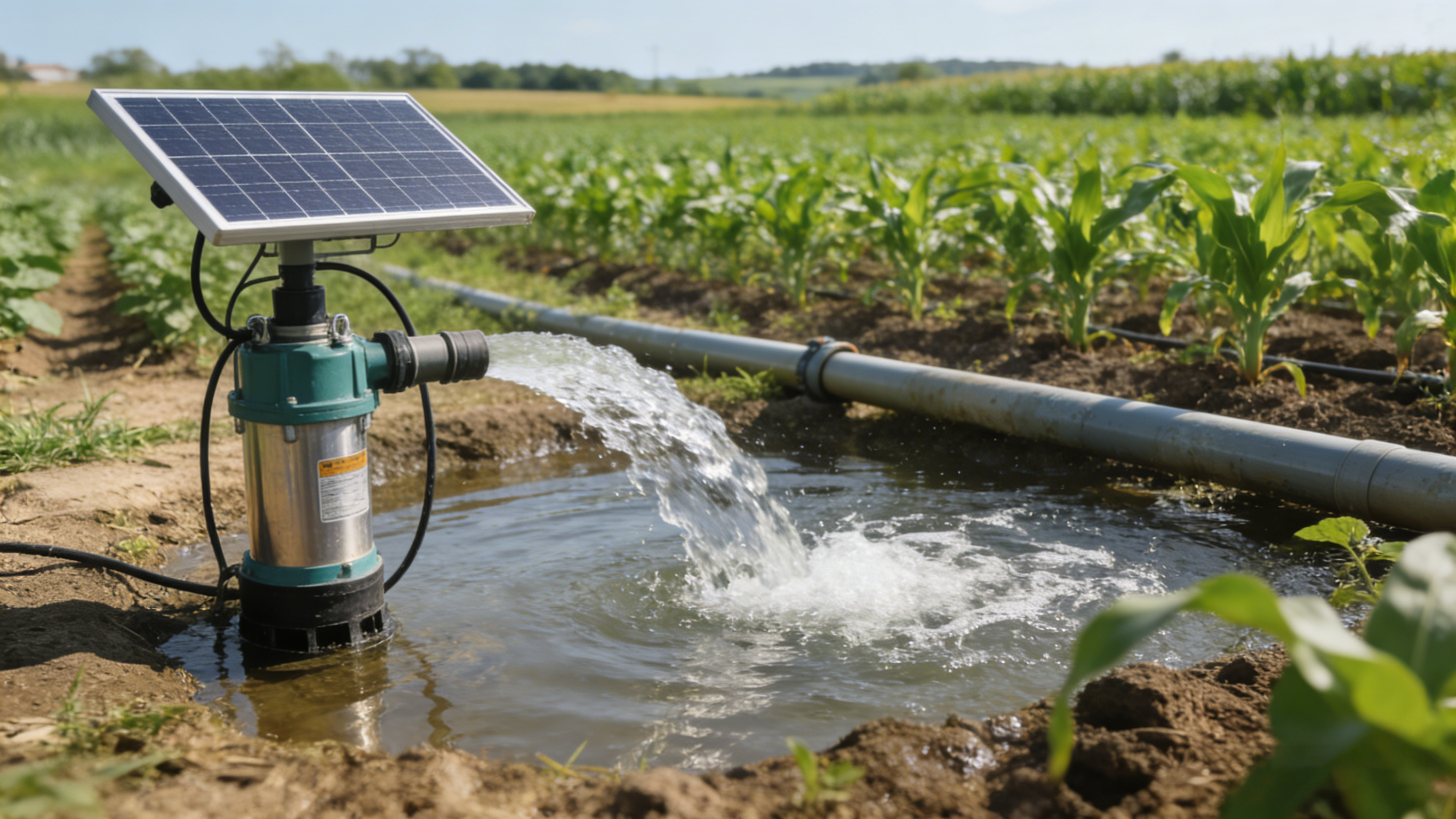
With your daily energy needs calculated, the next step is to figure out how many solar panels are required to meet that demand. This involves understanding solar panel ratings and accounting for environmental factors.
The amount of energy a solar panel can produce is directly related to the amount of sunlight it receives. This is measured in "peak sun hours," which refers to the number of hours in a day when the sun's intensity is at its peak (1,000 watts per square meter).
Peak sun hours vary significantly based on your geographical location and the time of year. For example, a location in Arizona might get 6-7 peak sun hours per day, while a location in Maine might only get 3-4. You can find peak sun hour data for your specific area from resources like the National Renewable Energy Laboratory (NREL).
For solar water pumping, it's wise to use the figure for the season with the least sunlight when your pump will be needed, like winter or the cloudiest season, to ensure year-round reliability.
Solar panels are rated by their power output in watts, measured under Standard Test Conditions (STC). Common panel sizes for residential or small-scale use range from 100 watts to over 400 watts.
However, real-world conditions are rarely perfect. Factors like high temperatures, cloudy weather, and panel orientation will reduce the actual output. A general rule of thumb is to account for system losses by assuming the panels will operate at about 75-85% of their rated capacity.
Now you can calculate the total solar wattage needed. Divide your daily energy consumption by the number of peak sun hours for your location, and then factor in system inefficiencies.
Total Solar Wattage (W) = Daily Energy Consumption (Wh) / (Peak Sun Hours × System Efficiency)
Let's continue with our example:
Daily Energy Consumption: 2,000 Wh
Peak Sun Hours: 4 hours (a conservative estimate)
System Efficiency: 0.80 (or 80%)
Total Solar Wattage = 2,000 Wh / (4 hours × 0.80) = 2,000 / 3.2 = 625 watts
This means you need a solar array with a total rated capacity of at least 625 watts.
To find the number of panels, divide this total wattage by the wattage of the individual panels you plan to use.
If you use 250-watt panels: 625 W / 250 W/panel = 2.5 panels. Since you can't have half a panel, you would need to round up to 3 panels.
If you use 100-watt panels: 625 W / 100 W/panel = 6.25 panels. You would need to round up to 7 panels.
In general, it's always a good idea to oversize your solar array slightly (by about 25%) to account for unexpectedly cloudy days or a future increase in water demand. This ensures your submersible solar pump system remains reliable.
Sizing your solar panels correctly is the most critical step in building a reliable submersible solar pump system. By carefully calculating your pump's energy needs and considering your local climate, you can create a setup that provides consistent water flow powered entirely by the sun. Once you have a clear idea of your requirements, you can start exploring specific solar panels and other system components, like charge controllers and inverters, to bring your off-grid water solution to life.


