
Views: 0 Author: Site Editor Publish Time: 2025-12-02 Origin: Site


As energy costs rise, homeowners are looking for smarter, more sustainable ways to power their homes. One of the biggest energy consumers in any household is the heating, ventilation, and air conditioning (HVAC) system. Pairing a high-efficiency AC heat pump with a solar panel system is an excellent way to reduce electricity bills and your carbon footprint.
But how many solar panels do you actually need to run an AC heat pump? The answer isn't a single number; it depends on several factors, including the size of your heat pump, your local climate, and how much sunlight your home receives. This guide will walk you through the calculations and considerations to help you determine the right size solar array for your needs.
A heat pump is an incredibly efficient electrical device that provides both heating and cooling. In the summer, it functions like a standard air conditioner, moving heat from inside your home to the outside. In the winter, it reverses the process, extracting heat from the outdoor air (even when it's cold) and transferring it inside. Because they move heat rather than generate it, heat pumps use significantly less energy than traditional furnaces or electric heaters.
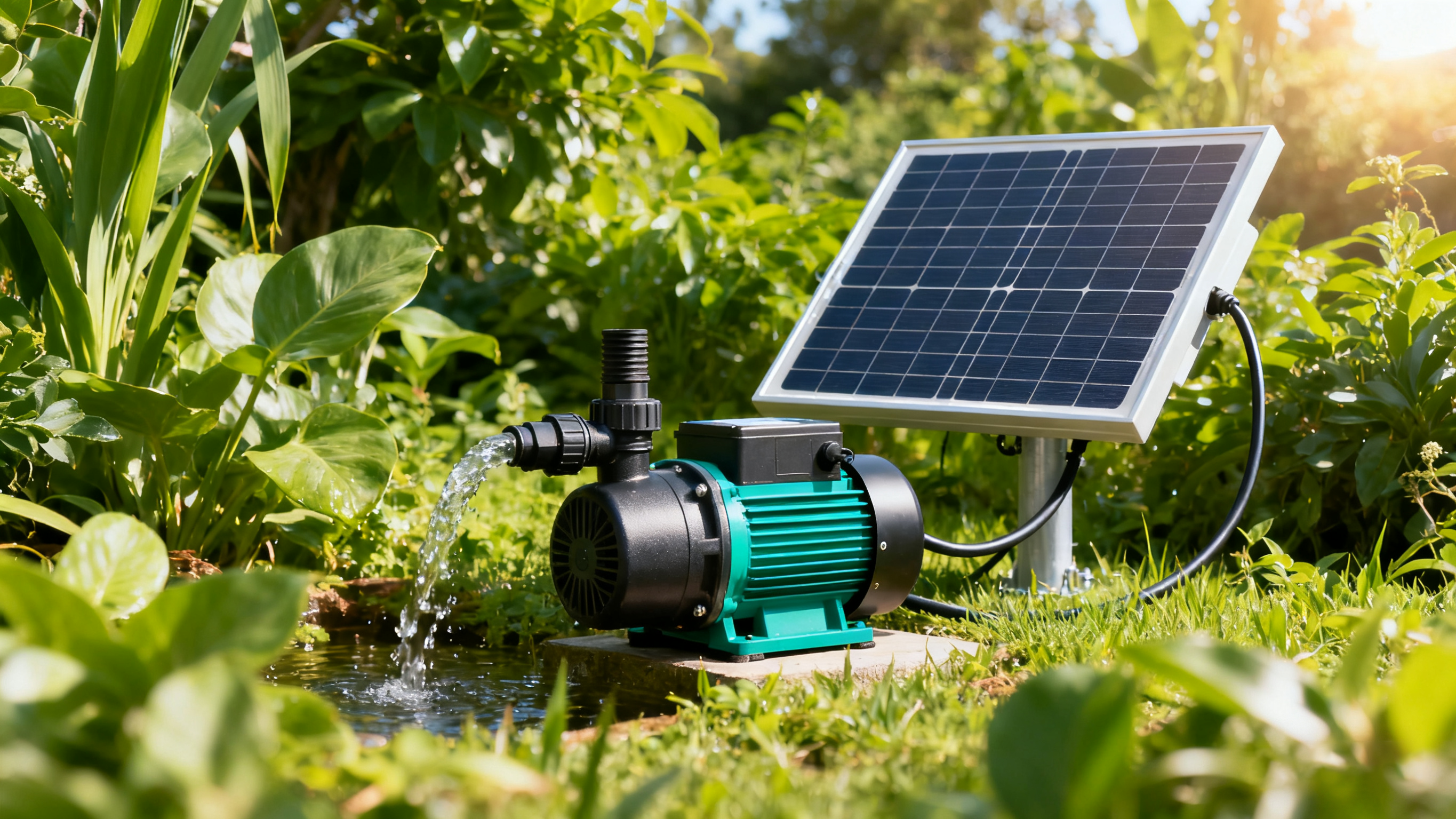
A solar AC pump system simply means you're powering this efficient appliance with electricity generated by solar panels installed on your property. The solar panels capture sunlight and convert it into direct current (DC) electricity. An inverter then changes this DC electricity into alternating current (AC) electricity, which is the standard form used by home appliances, including your heat pump. When your solar panels produce more electricity than your home needs, the excess can be stored in a battery or sent back to the electrical grid, potentially earning you credits with your utility company.
To figure out how many solar panels you need, the first step is to determine how much electricity your AC heat pump consumes.
The power consumption of a heat pump is measured in watts (W) or kilowatts (kW). You can usually find this information on the unit's specification label, in the owner's manual, or on the manufacturer's website. Heat pumps are often sized by "tons," which refers to their cooling capacity. A typical residential heat pump might be between 2 and 5 tons.
As a general rule of thumb:
1-ton unit: ~1,200 watts per hour
2-ton unit: ~2,400 watts per hour
3-ton unit: ~3,600 watts per hour
4-ton unit: ~4,800 watts per hour
5-ton unit: ~6,000 watts per hour
Let's use a 3-ton (3,600-watt) heat pump as an example for our calculations.
Next, estimate how many hours per day your heat pump will run. This will vary greatly depending on your climate, the season, your home's insulation, and your personal comfort preferences.
In a moderate climate: You might run it for 6-8 hours per day.
In a hot climate (like Arizona): It could be running for 10-12 hours or more during the summer.
In a cold climate (like Maine): You might use it for heating for 8-10 hours during winter days.
For our example, let's assume the heat pump runs for an average of 8 hours per day.
To calculate the total daily energy consumption in watt-hours (Wh), you multiply the wattage by the hours of use:3,600 watts * 8 hours = 28,800 Wh
To convert this to kilowatt-hours (kWh), which is how utility companies measure electricity, divide by 1,000:28,800 Wh / 1,000 = 28.8 kWh per day
Now that you know your heat pump needs about 28.8 kWh per day, you can figure out how many solar panels are required to generate that amount of electricity.
"Peak sun hours" don't refer to the total number of daylight hours. Instead, it's the average number of hours per day when the sunlight is intense enough for your solar panels to operate at their peak power rating. This number varies significantly by location. For example, a city in Arizona might get 6-7 peak sun hours, while a city in the Northeast might only get 3-4.
You can find the peak sun hours for your specific area using online maps and calculators from sources like the National Renewable Energy Laboratory (NREL).
Let's assume our example home is in a location that receives an average of 5 peak sun hours per day.
Solar panels come in various wattage ratings, typically ranging from 300 to 500 watts for residential use. Higher-wattage panels produce more electricity but are also more expensive. For our calculation, let's use a common panel size: 400 watts.
First, calculate the total daily energy production of one solar panel:Panel Wattage * Peak Sun Hours = Daily Energy Production per Panel400 watts * 5 hours = 2,000 Wh or 2 kWh per day
Now, divide your heat pump's daily energy needs by the daily energy production of a single panel:Total Panels Needed = Daily Energy Needed / Daily Production per Panel28.8 kWh / 2 kWh per panel = 14.4 panels
Since you can't install a fraction of a panel, you would need to round up. In this scenario, you would need 15 solar panels just to power your 3-ton AC heat pump.
The calculation above is a simplified estimate. In reality, several other variables can affect the number of panels you'll need.
No solar system is 100% efficient. Energy is lost during the conversion from DC to AC power, through wiring, and due to factors like dust on the panels or high temperatures. A conservative estimate is to account for about a 15% efficiency loss. To do this, you can increase your required panel count by 15%.
15 panels * 1.15 (115%) = 17.25 panels
So, you would need to round up to 18 panels to be safe.
Solar panels only generate electricity when the sun is out. If you want to run your AC heat pump at night or on cloudy days, you'll need a solar battery storage system. A battery stores the excess energy your panels produce during the day for later use. Adding a battery increases the upfront cost of your system but provides energy independence and resilience against power outages.
Most homeowners don't install a solar system just for their heat pump. It's more practical and cost-effective to size a system that can cover the electricity needs of your entire home. To do this, you would analyze your past electricity bills to determine your average daily or monthly kWh usage and perform the same calculations to size a system that offsets most or all of your consumption.
Determining how many solar panels you need for a solar AC pump system involves a few key calculations, but it's a manageable process. By understanding your heat pump's energy consumption, your local sun exposure, and the output of modern solar panels, you can get a reliable estimate for your project.
While this guide provides a strong starting point, the best way to get a precise answer is to consult with a professional solar installer. They can perform a detailed site assessment, analyze your energy usage, and design a system perfectly tailored to your home and budget. Making the switch to solar is a significant investment, but with the right planning, it’s one that will pay dividends for decades to come.


